Real Immersive Stereo Photography
Immersive photo viewing creates a sense of being inside a picture by letting users interactively explore panoramas, zoom, and pan, often using VR/AR or special software, making flat images feel like experiences, with technologies ranging from NASA's early 3D imaging to modern AI-driven viewers that blend digital content with reality. It's achieved through stitching multiple photos, specialized cameras, or AI to provide spatial awareness and presence, transforming static images into dynamic, explorable environments.
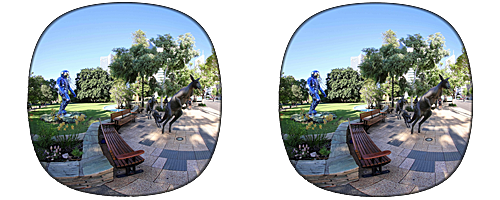
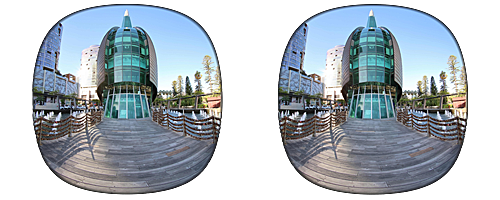
Real Immersive Stereo Photography is focused on images captured photographically using techniques and/or equipment that approach that of the naked human eye. This is typically referred to as VR180 which typically requires equipment that incorporates fisheye lenses. The basical principal of capturing separate left and right eye images applies as with real stereoscopic photography.
VR360 3D uses equipment with muplile fisheye lenses mounted in a horizontal ball arrangement, it is still VR 180 with the difference being that now you can effectively rotate your horizontal point of view without any limitation.
Key Rules and Principles for Immersive Stereo Photography
Immersive photography aims to transport the viewer into the scene, creating a sense of "being there" rather than just looking at a picture. This is achieved through specific compositional, technical, and storytelling techniques that prioritize depth and emotional connection.
Composition for Immersion
| Aspect | Description |
|---|---|
| Establish Depth | Include distinct foreground, middle ground, and background elements. Including close-up objects (like flowers or rocks) provides a "window" that pulls the viewer into the distance. |
| Use Foreground Interest | Place interesting, relevant objects very close to the camera lens to create a strong anchor point for the viewer. |
| Use Leading Lines | Use natural or architectural lines such as roads, rivers, or fences to point toward the main subject, creating a visual path for the viewer to follow. |
| Get Physically Close and Prioritize Wide-Angle Perspectives | Getting close to the subject makes the viewer feel part of the scene, strengthening storytelling and emotional connection. Use wide-angle lenses to exaggerate foreground elements and distance, drawing the viewer deeper into the image, particularly for dramatic, expansive scenes. |
| The Rule of Space | Fill the Frame (or Use Wide Negative Space). Either get extremely close to a subject to emphasize detail, or use wide, minimalist spaces to create a sense of scale and atmosphere. Leave "negative space" in the direction a subject is moving or looking. This gives the subject room to "breathe" and invites the viewer to follow their gaze. |
| Use Even and Natural Lighting | Immersive cameras capture everything and traditional studio lights are difficult to hide. Use natural, ambient light, or practical lights (lamps, windows) that fit the scene. High Dynamic Range (HDR) is essential to balance bright highlights and dark shadows. |
| Respectful Proximity | In street or event photography, get close enough to capture intimate moments (expressions, body language) while reading the scene's body language and remaining respectful. |
| Rule of Thirds | Avoid centring your subject. Place key elements along a grid that divides the frame into thirds to create more dynamic and natural-feeling balance. |
| Framing | Use environmental elements like windows, arches, or overhanging branches to "frame" your subject, which concentrates the viewer's attention and adds context. |
| Eye Level Perspective | Shooting at eye level helps the viewer feel like they are an active participant in the scene rather than an outside observer. Alternatively, extreme low or high angles can reveal details a person wouldn't normally see, increasing the sense of discovery. |
| Keep Foreground Clear | Avoid cluttering the foreground with distracting elements, like fingers or excessive, stray objects. |
| Central Camera Positioning | Position the camera where the viewer's eyes would be in the real scene. A central, "eye-level" location provides a balanced, natural perspective, which is crucial for reducing vertigo or discomfort. |
Technical Considerations
| Aspect | Description |
|---|---|
| High Resolution | Use cameras that capture high resolution images/video (at least 16MP per image per stills or 5.7K or higher for video) to maintain clarity when the image is wrapped around the viewer, ensuring the "reality" remains convincing. Generate high resolution final images that are sharp. When viewers zoom into the final image images with low resolution and sharpness will lose impact. |
| High Dynamic Range (HDR) | Use HDR techniques to balance exposure in high-contrast scenes, ensuring detail is visible in both shadows and bright highlights. |
| Maximum Sharpness / Depth of Field | Often, a deep depth of field (high f-number, like f/11 or f/16) is needed to keep both foreground and background in focus. |
| Avoid Distortion | While wide lenses are good, be careful of extreme, unnatural distortion unless it is a creative choice. |
| Keep the Horizon Level | Cameras must be perfectly level. In VR, any tilt can cause a vertical offset that leads to immediate nausea for the viewer. |
| Minimize Camera Movement | If the camera must move, maintain a constant speed and move forward, as this is the most comfortable for human perception. Avoid panning (rotating the camera) at all costs, as it is a major cause of motion sickness. If the camera must move, keep it linear and avoid acceleration or "panning" (rotation), which is highly disorienting in headsets. Use gimbals or tripods to avoid jerky movements, which cause motion sickness. |
| Remove or Hide Tripods / Rigging | The camera support, or even the photographer, can break the illusion of presence. Use a small, thin monopod or tripod, or remove the apparatus in post-processing to create a "grounded" feeling for the viewer. |
| The "Cockpit" Effect | If movement is necessary, include a static reference point in the frame (like a car dashboard) to help the viewer stay grounded. |
| Lens Cleanliness | Smudges on fisheye lenses are magnified in immersive formats, causing uncomfortable glares or "stitching" artifacts where images are joined. |
| Match Lighting and Colour Temperature | For stitched/stereoscopic images, ensure that all lenses record consistent colour and exposure. |
| High Frame Rates (Video) | Aim for at least 60fps (90fps is ideal for high-end headsets like the Apple Vision Pro) to match how we perceive the real world and reduce visual lag. |
| Avoid panning (Video) | Panning, or rotating the camera, is an aggressive acceleration and is almost guaranteed to cause nausea. Avoid panning at all costs. If a pan somehow ends up in an edit, one way to mitigate is to “blink” the scene during the pan (quickly dip to black during the pan). |
Immersive Storytelling and Emotional Guidelines
| Aspect | Description |
|---|---|
| Involvement Perspectives | Decide the viewer's role: are they a "true observer" (invisible to characters), a "sidekick" (interacted with), or "POV" (taking over a character's body)? |
| Focus on mood | Focus on the mood and "heart" of a moment rather than just documenting a pretty view. Shift the perspective from "I want to take this photo" to "I am experiencing this," capturing the mood, atmosphere, and emotional essence of the place. |
| Embrace Ambient Light and Shadows | Instead of hiding them, use high-contrast lighting or silhouettes to create a sense of drama and mystery. |
| Be Patient and Observe | Invest time in observing your surroundings to discover unique, compelling viewpoints and stories rather than rushing for a quick, standard shot. Wait for a "connection" with the subject. Immersion requires staying in a scene longer than it takes to get a quick snapshot to truly understand its mood. |
Ethical Guidelines
| Aspect | Description |
|---|---|
| Ethical Consent | In 360-degree or high-immersion formats, be mindful of privacy. Always aim to gain explicit consent from identifiable individuals in private or sensitive settings. When capturing 360-degree images that include bystander, get permission, especially in private or sensitive areas. |
| Privacy | Be mindful of privacy laws in different jurisdictions. |
Key Aspects of Immersive Photography
Key Aspects of Immersive Viewing
| Aspect | Description |
|---|---|
| Spherical Capture | Images cover a spherical view which may be contrained by a single focus point or have a rotatable point of focus. |
| User-Defined Framing | The viewer controls the angle and zoom, effectively "cutting out" their own view from the scene |
| Interactive Exploration | Viewers can pan and/or zoom, making them feel present in the scene. |
Technologies & Experiences
| Technology | Experience |
|---|---|
| Virtual / Augmented Reality | VR headsets place you fully in the scene, while AR can overlay digital photos onto your real-world environment. |
| AI-Powered Platforms | Software uses AI to understand depth and blend virtual content with physical space for more realistic immersion. |
| Specialized Viewers | Apps and online tools (like immerGallery, RenderStuff, Immersity) allow creation and viewing of immersive galleries which may interactive elements like background music or environmental effects. |
How It Works
| Workflow | Description |
|---|---|
| Capture | VR 180 images are captured with a pair of fisheye lenses pointing in the same direction (left and right eyes). VR 360 multiple 'single' cameras, each pointing in a diffrent direction where the ovelapping images can be stitched together using photogrammetry to generate horzontally offset panoramas (left and right eyes). |
| Processing | Software stitches images and detects media formats (like VR180, 360° mono/stereo). |
| Viewing | Special software renders the image, allowing interactive navigation on monitors, phones, or VR headsets. |
Curvilinear (Fisheye) vs Rectilinear (Wideangle)
Rectilinear lenses keep straight lines straight, mimicking human vision with minimal distortion (ideal for architecture), while curvilinear lenses (like fisheyes) intentionally curve straight lines, creating a distorted, hemispherical, or bulging effect for a wider field of view, common in creative photography or surveillance. The key difference is straight lines: rectilinear preserves them, curvilinear bends them.
| Aspect | Curvilinear | Rectilinear |
|---|---|---|
| What they do | Intentionally introduce barrel distortion, causing straight lines to bulge outwards, creating a spherical, fish-eye look. | Render straight lines as straight lines in the image, correcting for barrel distortion, similar to how the human eye perceives things. |
| Appearance | Exaggerated perspective, curved lines, especially prominent towards the edges. | Realistic, proportional, with minimal distortion, though edges can stretch. |
| Best for | Creative shots, capturing extremely wide scenes (120°+), dramatic effects, or full-room surveillance. | Architecture, landscapes, product shots, and any situation where straight lines (buildings, horizons) are crucial. |
| Examples | 120°+ images captured using fisheye lenses (Kandao Obsidian variants/Insta360 variants/Canon VR lenses/Calf Visinse, ViewPT Realia/Slam XCAM). Cameras with fisheye wideangle lenses | Apple/Android Spatial Images captured on a smartphone. Cameras with rectilinear wideangle lenses |
| Usage | Choose curvilinear (fisheye) for 120°+ immersive photography and you have an appropriate means to view curvilinear images. | Choose rectilinear for realism and straight lines and you don't have an appropriate means to view curvilinear images. |
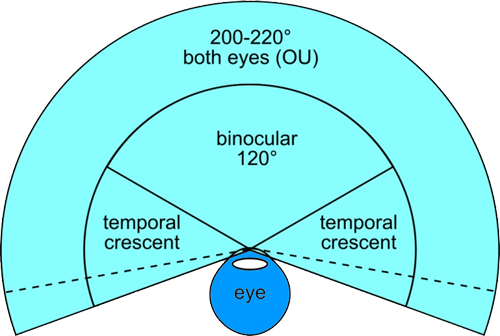
Normal Human Binocular Field of View (FoV)
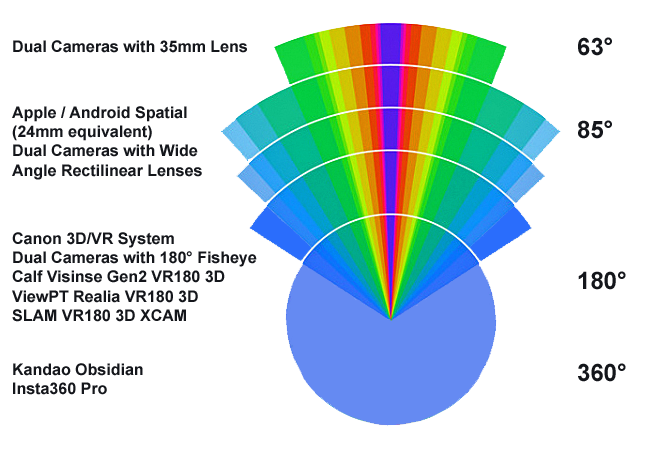
Immersive Stereo Photography System Field of View (FoV) Comparison
As a simplistic interpretation, Rectilinear is used where capture falls within the normal range of huma binocular vision, Curvilinear is used where capture falls outside the normal range of huma binocular vision.
Immersive Stereo Photography Capture Systems
There are a variety of systems/cameras that can be used to capture immersive stereo photographs and videos.
360° Curvilinear Stereo Photography Capture Systems
| System | Description | Image |
|---|---|---|
| Insta360 Pro 2 | Captures 8K 3D VR video using six internal lenses. Includes a long-range transmitter for remote control up to 300m (ground-to-ground) or 1km (ground-to-air). 228mm diameter with eight f3.2 200° Fisheye Lenses. | 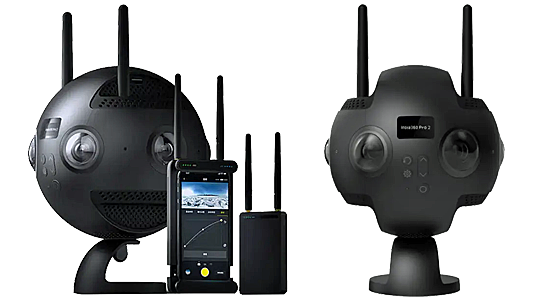 |
| Insta360 Pro Titan | The Insta360 Titan is a professional-grade 360 VR camera designed for high-end cinematic production, featuring eight Micro Four Thirds sensors and the ability to capture video at 11K resolution. | 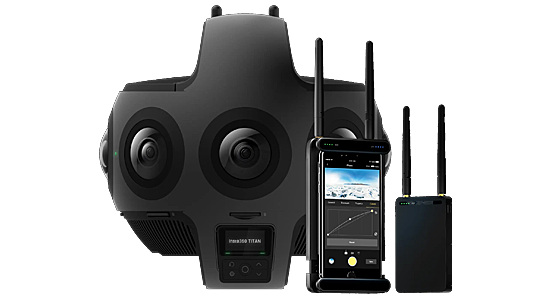 |
| Kandao Obsidian Pro | The Kandao Obsidian Pro is a professional-grade 12K 3D 360-degree cinematic virtual reality (VR) camera, designed for high-end film production and live streaming. It features eight APS-C sensors and f/2.8 fisheye lenses, capturing highly detailed raw footage with a wide dynamic range. 135° horizontal FOV, 195° vertical FOV | 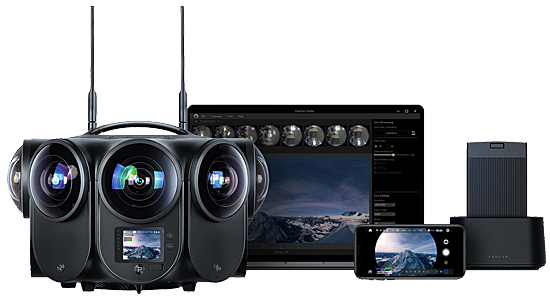 |
| Kandao Obsidian R / S | The Kandao Obsidian R is a professional 3D 360-degree virtual reality (VR) camera known for its high-speed video capture, making it ideal for slow-motion effects. It is designed for professional VR content creators and filmmakers. It features six high-quality fisheye lenses, each with a bright f/2.4 aperture. | 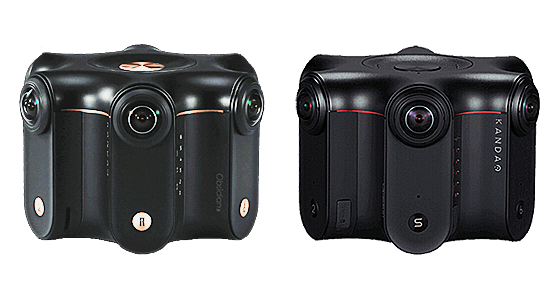 |
| Kandao Obsidian Go | The Kandao Obsidian Go uses six f/2.0 synced high-quality wide-angle fisheye lenses, each paired with a 16-megapixel back-illuminated CMOS sensor, to capture fully spherical content. Photo Resolution: Up to 8K (7680x7680) panoramic photos in both 2D and 3D. | 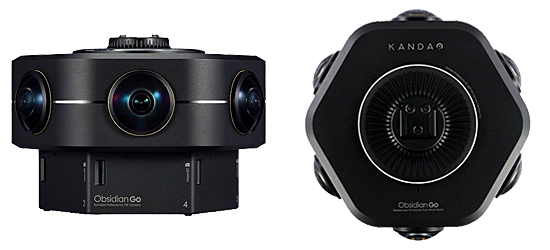 |
180° Curvilinear Stereo Photography Capture Systems
| System | Description | Image |
|---|---|---|
| Canon Full frame RF 5.2mm f/2.8L Dual Fisheye | The Canon Full frame RF 5.2mm f/2.8L Dual Fisheye is designed specifically for capturing immersive 180° stereoscopic 3D VR content. Wide f/2.8 aperture excels in low light and provides a shallow depth of field, with a range down to f/16. Delivers a massive 190° stereoscopic field of view for immersive experiences. The Canon RF 5.2mm f/2.8L Dual Fisheye lens is compatible with full-frame RF-mount cameras like the EOS R5 Mark II, EOS R5 (firmware ver. 1.5.0 or later), EOS R6 Mark III, EOS R6 Mark II (firmware ver. 1.2.0 or later), EOS C400, EOS C80, EOS C50, EOS R5 C (firmware ver. 1.0.5 or later) This lens does not have auto-focus and a restriced range of manual focus. If you use an aperture of f8 or smaller, the hypofocal range is sufficient. |
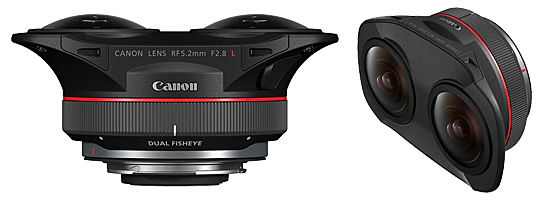 |
| Canon Crop frame RF-S 3.9mm f/3.5 STM Dual Fisheye | The Canon RF-S 3.9mm f/3.5 STM Dual Fisheye lens is a specialized lens for capturing stereoscopic 3D VR imagery to a single aps-c image sensor when paired with a compatible Canon EOS RF-S camera. The dual-lens design allows for capturing stereoscopic 3D 180° VR imagery. It has a 60mm interpupillary distance and a 144° field of view that mimics human vision for a realistic, immersive experience when viewed with a compatible display. The Canon RF-S 3.9mm f/3.5 STM Dual Fisheye lens is compatible with RF-mount aps-c EOS R cameras such as the EOS R7 (firmware ver. 1.6.0 or later), EOS R50 V, EOS R50 (firmware ver. 1.4.0 or later) This lens does have auto-focus. |
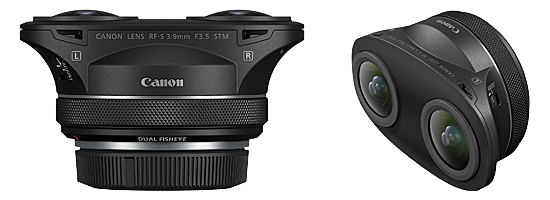 |
| Canon compact foldable 8K 3D VR camera Concept | This unreleased camera is in the ‘concept’ phase. However, a list of minimal specs was revealed. It appears that this 360/180 3D VR is capable of shooting 8K at 30 FPS, 4K at 120 FPS, and has live-streaming capabilities. Moreover, the camera is designed to be a compact camera capable of shooting both 360/180 VR images and video. Canon’s goal is to build an 8K VR camera that is compact, lightweight, and easy to use. | 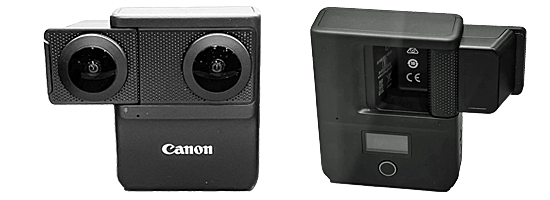 |
| SLAM VR180 3D XCAM | The SLAM VR180 3D XCAM is a consumer-grade 8K VR180 3D camera designed to function like a smartphone, allowing users to capture, edit, and share immersive content from a single device. Launched initially via crowdfunding on Kickstarter and Indiegogo in early 2025, it is positioned as an affordable alternative to professional VR rigs. Captures 12K spatial photo and up to 8K at 30fps or 6K at 50fps video in VR180 3D format. Dual flagship 1/1.5-inch CMOS sensors with 10-bit colour support. Features 65mm dual-lens spacing, closely mimicking the interpupillary distance (IPD) of human eyes for a natural 3D effect. | 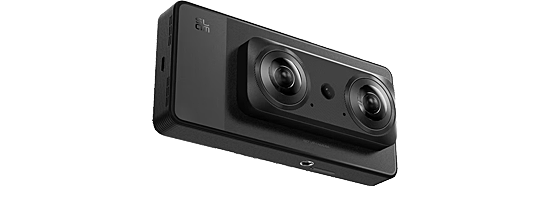 |
| Calf Visinse Gen2 VR180 3D | The Calf Visinse Gen2 is a consumer-grade 3D VR180 camera designed for lightweight, portable spatial video and photo capture. Positioned as an affordable alternative to professional VR rigs, it features dual lenses and supports high-resolution recording up to 8K. Capable of 8K at 30 fps and 6K at 50 fps (after firmware updates). Dual Sony IMX577 1/2.3" 12M pixel CMOS sensors. Features 65mm dual-lens spacing, closely mimicking the interpupillary distance (IPD) of human eyes for a natural 3D effect. While offering high resolution, the dynamic range may be limited in low-light or high-contrast environments. | 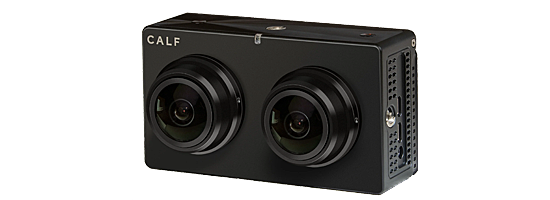 |
| ViewPT Realia VR180 3D Camera | The ViewPT Realia VR180 3D camera is a professional-level VR180 camera known for its high image quality and robust metal build. It is designed for capturing immersive 3D video content in resolutions up to 8K. Supports 8K 30fps, 6K 50fps, and 4K 50fps VR180 video. Features 6-axis gyro information used in post-processing software for stabilization, allowing for handheld shooting. Users praise the camera's ability to capture vibrant colors and fine details, even in challenging lighting like sunsets. The ViewPT Realia VR180 3D camera has a fixed Interpupillary Distance (IPD) of approximately 65mm. | 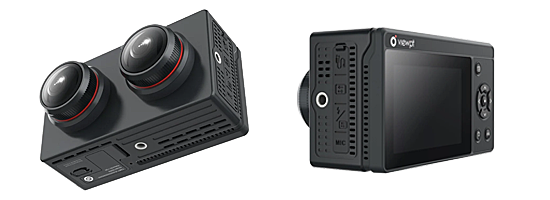 |
| Dual Cameras with Fisheye Lenses | Appropriate fisheye lenses can be attached to compatible cameras that form part of a viable paired camera rig. For example the pictured TTARTISAN 7.5mm f2.0 aps-c large aperture with 180° angle of view fisheye lens is a good for creating immersive panoramas and VR experiences. When used with a full frame camera this aps-c lens creates circular fisheye images on the full frame sensor whereas full frame fisheye lenses may crop a small portion of the captured image at the upper and lower margins. When using fisheye lenses with a FoV that is greater than 180° on a paired camera rig may result in the lenses capturing a small part of each other. | 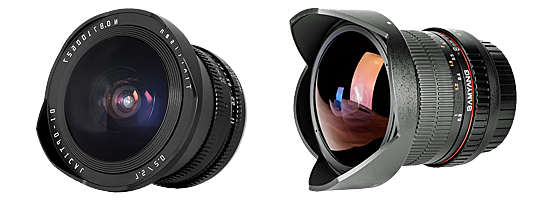 |
180° Hybrid Curvilinear and Rectilinear Stereo Photography Capture Systems
| System | Description | Image |
|---|---|---|
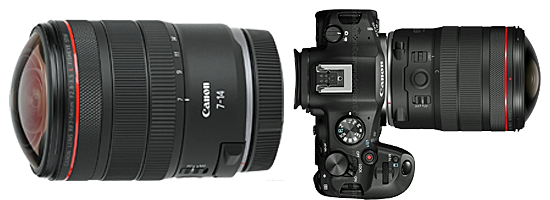
| Dual Cameras with Fisheye Zoom Lenses | The Canon RF 7-14mm f/2.8-3.5L Fisheye STM is a specialized lens offering a zoom range that captures a unique full circle 190° field of view at 7mm to a full sensor covering 180° diagonal fisheye view at 14mm. It provides superb, sharp optical quality for immersive landscapes, action sports, and VR content. The Canon RF 7-14mm f/2.8-3.5L Fisheye lens is most compatible with the EOS R6 Mark III camera if you want to process images using the EOS VR Utility. This lens does have auto-focus. |
 |
Wide Angle Rectilinear Stereo Photography Capture Systems
| System | Description | Image |
|---|---|---|
| Apple iPhone Spatial Photos and Videos | Images or video is captured using the iPhone's ultrawide and main cameras simultaneously. The ultrawide camera has a resolution of 48MP and a 120° FoV whilst the main camera has a resolution of 48MP and a 84° FoV. The image from the ultrawide is cropped to reduce the effective FoV to be the same as the main camera. This 70% reduction vertically and horizontally results in the ultrawide having an effective resolution of just under 24MP. The interpupillary distance of the Wide and Ultra Wide lenses is 20mm. This mismatch in lenses creates a perceptible difference in image quality between the left and right images which can cause viewer discomfort with some subject matter. | 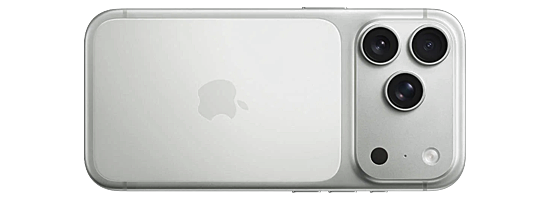 |
| Apple Vision Pro | The Apple Vision Pro can also capture spatial photo and video with its stereoscopic 3D main camera system which has 18 mm f/2.00 aperture lenses which capture 6.5 stereo megapixels. The interpupillary distance is similar to the average human IPD at 64 mm. Apple's Spatial Photo format is a specialized multi-image HEIC file containing a left-eye view, a right-eye view (stereo pair), and crucial spatial metadata. This data allows the Apple Vision Pro and compatible devices to render immersive 3D photos with an 84° FoV. | 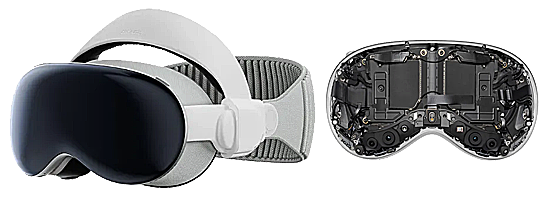 |
| Android iPhone Spatial Photos and Videos | Many Android Base Smartphones now have rear wide and ultrawide cameras with high resolution cameras and sensors which can be used to capture Spatial Photos 3D photos and videos with custom camera applications. As an example the Google Pixel 10 Pro / Pro XL has a rear wide camera with 50MP, f1.68, 82° FoV and a 1/1.31" sensor and an ultrawide camera with 48 MP, f1.7, 123° FoV and a 1/2.55" sensor. The interpupillary distance of the Wide and Ultra Wide lenses is approximately 15mm. | 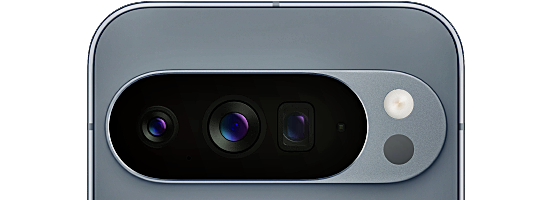 |
| Dual Cameras with Wide Angle Lenses | A wide-angle lens captures a broader field of view than the human eye, using shorter focal lengths (typically under 35mm) to fit more of a scene into the frame, ideal for landscapes, architecture, and tight spaces by emphasizing depth, scale, and dramatic perspectives. Generally shorter than normal lenses (e.g., 14mm, 24mm), with ultra-wide angles below 24mm. | 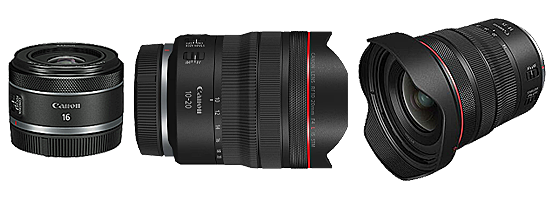 |
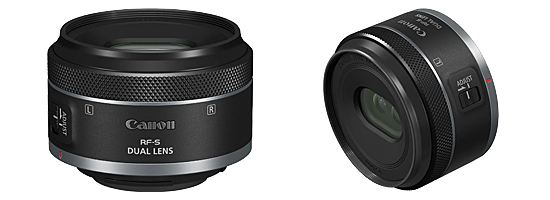
| Canon RF-S 7.8mm f/4 STM Dual Lens | The Canon RF-S 7.8mm f/4 STM Dual Lens is a specialized wide-angle, stereoscopic lens designed for capturing immersive 3D and VR content. It has a fixed 7.8mm focal length (equivalent to approximately 12.6mm on a full-frame camera). It is designed for APS-C RF-mount cameras and is specifically optimized for use with the Canon EOS R7. This lens does have auto-focus. |
 |
Immersive Stereo Photograph Capture Formats
Immersive photograph capture formats enable the creation of 360-degree, 3D, or spatial images that allow viewers to feel present within the scene rather than just looking at a flat image. These formats range from consumer-friendly 360-degree photos to high-end spatial, volumetric, and light-field captures.
| Format | Description |
|---|---|
| 360° Equirectangular (Spherical) Photos | These capture everything around the camera. They are usually stored as single 2:1 aspect ratio images (monoscopic) or stacked 1:1 images (stereoscopic). Stitched from multiple fisheye lenses. |
| Spatial Photos (MV-HEVC) | Specifically for Apple Vision Pro, these store two separate 180-degree stereoscopic views within a single container file, providing a 3D effect with depth. |
| VR180 (Stereoscopic 180) | Captures only the forward-facing 180-degree view in 3D. This format is often favored over 360 because it is easier to produce, lacks visible seams, and allows the photographer to stand behind the camera. |
| Light Field Photography | Captures only the forward-facing 180-degree view in 3D. This format is often favored over 360 because it is easier to produce, lacks visible seams, and allows the photographer to stand behind the camera. |
| Volumetric/3D Mesh Capture | Uses LiDAR or photogrammetry to turn real-world objects into 3D models. These can be viewed from any angle in a 3D space. |
Immersive Stereo Photography Viewing Systems
Immersive stereo photography viewing systems encompass a range of technologies that allow users to explore photographs in an all-encompassing, interactive manner, simulating the feeling of presence within the captured scene. These systems primarily rely on 360-degree imagery, Virtual Reality (VR), and Augmented Reality (AR).
Key Technologies and Systems
| Technology | Description |
|---|---|
| 360-Degree/Panoramic Imaging | This technique captures a complete spherical view from a single, fixed point using specialized multi-lens cameras or single cameras with fisheye lenses. The individual images are "stitched" together using software to create a seamless panorama. These images can be viewed on standard web browsers (by dragging the view with a cursor/finger) or in VR headsets. Applications include real estate virtual tours (e.g., Matterport, Google Street View), tourism, and event documentation. |
| Virtual Reality (VR) Headsets | VR headsets like the Apple Vision Pro or Meta Quest devices provide the most immersive experience, filling the user's entire field of view. When paired with 360-degree or 180-degree stereoscopic content, they create a compelling sense of depth and scale, allowing the viewer to naturally look around the virtual environment. |
| Augmented Reality (AR) Devices | AR devices overlay digital information onto the user's view of the real world. In photography, this can involve bringing a still image to life with interactive digital elements or viewing "spatial photos" (3D photos) captured by devices like modern smartphones. |
| Specialized Software | Stitching/Editing Software: Tools like Adobe Photoshop or dedicated programs (e.g., PTGui) are used to process images. |
| Specialized Viewing Platforms | Content is often displayed on dedicated websites, VR content libraries, or social media platforms that support 360-degree interactive playback. |
| Professional Tools | Professional workflows use software like DaVinci Resolve Studio to edit content from high-end cameras like the Blackmagic URSA Cine Immersive. |
| Mapping/GIS Integration | Systems like the LP360 Immersive Image Explorer allow navigation through images aligned with point cloud data, similar to Street View, for professional analysis and mapping. |
Summary of Viewing Methods
| Method | Description | Interactivity | Hardware Needed |
|---|---|---|---|
| Desktop/Mobile | Viewing on a flat screen with a web browser or app. | Cursor dragging or screen swiping to pan/tilt. | Standard computer, smartphone, or tablet. |
| VR Headset | Headset fills the user's field of view with the image/video. | Natural head movements change the perspective, creating true immersion. | VR headset (e.g., Meta Quest, Apple Vision Pro). |
| AR Devices | Overlays digital data onto the real world view. | Interaction with digital elements within the real environment. | AR glasses, smartphone, or tablet |
Augmented Reality Headsets & Glasses
The most used devices for viewing Immersive Stereo Photographs are VR headsets. VR headset Field of View (FoV) varies significantly, with standard consumer models offering around 90-100 degrees, while premium options push 110-120+ degrees for greater immersion, though wider FoV demands more processing power and can impact sharpness. Wider FoVs reduce the "goggle effect," but higher resolution (PPD - Pixels Per Degree) is crucial to maintain clarity, balancing immersion with visual fidelity.
| Type | FoV Range | Examples |
|---|---|---|
| Standard Consumer | ~90° - 104° | Quest 2, Pico 4 |
| Mid-Range/Improved | ~104° - 110° | Quest 3, Steam Frame, Apple Vision Pro |
| High-End/Pro | ~110° - 120°+ | HTC VIVE Pro 2, Varjo XR-4, Pimax models |
Key Considerations Immersion vs. Performance: A wider FoV brings the virtual world closer and reduces tunnel vision but requires more powerful hardware to render. Resolution (PPD): For a truly sharp image at a wide FoV, you need high resolution and pixel density (PPD) to avoid a blurry, pixelated look. Lens Technology: Pancake lenses allow for slimmer designs, while Fresnel lenses are common but can cause glare (god rays). Measurement Differences: FoV is often listed as horizontal, diagonal, or combined, making direct comparisons tricky; look for measured horizontal FoV for clarity.
VRcompare - The Internet's Largest VR & AR Headset Database can be found at the following link.
https://vr-compare.com/
Jeff Ewen 3D - creating real digital stereoscopic photographs.
Contact me by clicking here.